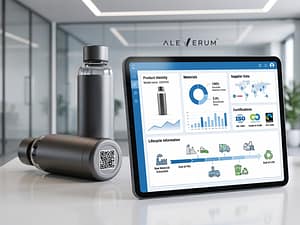






Modern supply chains are becoming increasingly dependent on trusted product information.
As Digital Product Passports, sustainability reporting requirements, interoperability frameworks, and machine-readable ecosystems continue evolving, organisations are under growing pressure to ensure product data is accurate, traceable, and supported by evidence.
This is where evidence verification becomes essential.
In the future, organisations may no longer be judged only by the claims they publish, but by their ability to prove those claims through trusted product-data systems.
The growing complexity of product ecosystems
Supply chains today involve a large number of participants, including:
- Suppliers
- Manufacturers
- Auditors
- Certification bodies
- Logistics providers
- Recyclers
- Procurement teams
- Regulators
- Technology platforms
Each participant contributes product information, evidence, declarations, lifecycle records, or compliance documentation.
In many organisations, this information still exists across disconnected systems, spreadsheets, emails, PDFs, and supplier portals.
This creates challenges around consistency, visibility, trust, and governance.
Why evidence matters more than claims
Many sustainability and compliance programs historically relied on static declarations or high-level reporting.
Future Digital Product Passport ecosystems are expected to require stronger links between claims and supporting evidence.
This means organisations may increasingly need to connect product claims to:
- Certificates
- Audit records
- Supplier declarations
- Test reports
- Lifecycle data
- Chain-of-custody evidence
- Compliance documents
- Product specifications
- Facility records
Without evidence verification, product information becomes difficult to trust at scale.
The shift toward trusted product-data systems
Future supply chains will likely depend on systems capable of structuring and governing trusted product information.
This includes the ability to:
- Collect supplier evidence
- Verify supporting documentation
- Track version history
- Identify expired records
- Detect missing information
- Review inconsistencies
- Structure machine-readable outputs
- Support interoperability workflows
As product ecosystems become more connected, organisations will increasingly need enterprise-grade product-data governance rather than isolated reporting workflows.
AI-assisted verification and product intelligence
As supply-chain complexity increases, manual review processes become harder to scale.
AI-assisted verification systems can help organisations accelerate evidence review and improve product-data quality.
These systems may support:
- Claim-evidence matching
- Missing-data detection
- Supplier-data review
- Risk scoring
- Standards mapping
- Interoperability checks
- Readiness scoring
- Evidence-quality analysis
The goal is not to automate trust entirely, but to help organisations review product information more efficiently and consistently.
Why interoperability changes everything
One of the biggest shifts happening across product ecosystems is interoperability.
Future product-data environments will increasingly require systems that can exchange structured information automatically between:
- Procurement systems
- Supplier platforms
- Digital Product Passports
- Compliance systems
- APIs
- Partner networks
- AI-assisted platforms
This means evidence itself may need to become machine-readable, structured, and connected to trusted product identities.
Disconnected PDFs and isolated spreadsheets may no longer be sufficient for future supply-chain environments.
Governance will become a competitive advantage
As organisations exchange more product information digitally, governance becomes increasingly important.
Organisations need visibility into:
- Who uploaded evidence
- What information changed
- Which claims were verified
- Which documents expired
- Which workflows were approved
- Which suppliers contributed data
- What information was shared externally
Strong governance supports greater trust across buyers, suppliers, auditors, and regulatory ecosystems.
The future of trusted supply chains
The future of supply chains will likely depend on structured, verifiable, and interoperable product data.
Evidence verification is becoming a foundational capability for organisations preparing for:
- Digital Product Passports
- Sustainability compliance
- Procurement transparency
- Machine-readable ecosystems
- AI-assisted workflows
- Interoperable product-data exchange
Organisations that prepare early may be better positioned as future product ecosystems become more connected and intelligence-driven.
How Aleverum™ supports evidence verification
Aleverum™ is designed to help organisations structure, verify, evaluate, and govern trusted product information across Digital Product Passport ecosystems.
The platform supports:
- Supplier evidence workflows
- Verification systems
- Product-data governance
- AI-assisted review
- Standards mapping
- Interoperability readiness
- Compliance workflows
- Machine-readable outputs
- Audit-ready product records
- Enterprise product intelligence
The goal is to help organisations prepare trusted product-data infrastructure for future connected ecosystems.
