





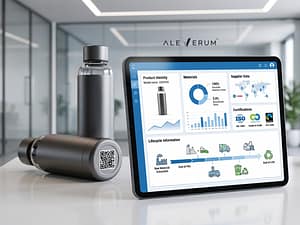

Digital product passport regulation is becoming an important consideration for Australian businesses that sell products into the European Union or supply companies that do. The key point is that the rules are not triggered simply because a business is Australian or because it exports generally. They depend on the product, the applicable EU legislation and the role of the economic operator placing that product on the EU market.
For exporters, preparation should begin with product scope and information readiness rather than with software or QR codes. A Digital Product Passport may need to connect product identity, materials, technical information, supplier data and other required records in a structured digital format. The exact requirements vary by product group and are being introduced progressively through product-specific rules.
Australian exporters do not need to assume that every product requires a passport today. A better approach is to understand which products are in scope, what information may be required and how that information will move between the Australian business and the relevant EU economic operators.
Does Digital Product Passport Regulation Apply to Australian Exporters?
Digital product passport regulation can affect Australian exporters when their products are placed on the EU market and fall within a product category subject to a Digital Product Passport requirement.
Being located outside Europe does not remove the practical need to provide information required for EU market access. Australian manufacturers may need to work closely with EU importers, distributors or other economic operators responsible for placing their products on the market.
How digital product passport regulation can affect Australian exporters
For products covered by applicable EU rules, the economic operator responsible for placing the product on the market may need to ensure that relevant conformity and Digital Product Passport requirements have been met.
For an Australian manufacturer, this can create an important information relationship with the European importer or other responsible economic operator.
The Australian business may need to provide product identifiers, technical records, supplier information, supporting evidence or other product data required under the relevant legislation.
This is why digital product passport regulation should be considered during export planning rather than treated only as a European compliance issue.
How digital product passport regulation depends on the product
Not every product entering Europe currently needs an EU digital product passport.
The framework is being introduced progressively through product-specific requirements. These rules can determine what information must be included, how the information is accessed and whether the passport applies at model, batch or individual item level.
Batteries are among the first major product groups approaching mandatory Digital Product Passport requirements, with relevant battery passport obligations beginning in February 2027. Other product categories are progressing through their own implementation pathways.
For Australian exporters, the practical first question is therefore not simply whether they need a DPP. It is which EU product rules apply to the product they intend to sell.
Understanding Responsibility in the EU Market
Digital product passport regulation involves different economic operators, including manufacturers, importers, authorised representatives, distributors and other parties defined under relevant legislation.
Australian exporters should understand these roles because responsibility for creating, maintaining or registering passport information may depend on how the product enters the European market.
How digital product passport regulation affects economic operators
Manufacturers may have responsibilities relating to product identification, technical documentation and conformity requirements.
Importers may also need to confirm that products entering the EU satisfy relevant requirements before they are placed on the market.
This does not mean every Australian exporter needs to establish itself as an EU economic operator.
It does mean that the Australian manufacturer and the European party responsible for market placement need a clear process for sharing required information.
Clear responsibilities can reduce confusion later, particularly when product records, technical documents or supplier evidence need to be updated.
How digital product passport regulation affects Australian supply chains
Digital product passport regulation can extend beyond the organisation that performs the final registration or market-entry process.
An Australian exporter may depend on material suppliers, component manufacturers or contract producers for information needed within its product record. The European importer may then depend on the exporter for information required to fulfil its own responsibilities.
This creates a chain of information responsibilities.
If important supplier information is missing, outdated or difficult to trace, the problem can move downstream until it reaches the organisation responsible for placing the product on the EU market.
Exporters can reduce this risk by identifying important product and supplier information early and establishing clear ownership for maintaining each record.
Preparing Product and Supplier Information Before Export

Digital product passport regulation is fundamentally an information requirement.
A passport can only be useful if the information behind it is accurate enough, structured appropriately and available when required.
For Australian businesses, this means export readiness may involve improving product information long before the goods arrive in Europe.
What digital product passport regulation means for product data
The exact information required depends on the applicable product-specific legislation.
Depending on the product category, this may include product identifiers, manufacturer information, importer information, technical documentation, facility details, compliance records and other relevant product information.
Some product categories may also require information relating to materials, environmental performance, repair, reuse or recycling.
Australian exporters should therefore avoid creating one generic passport template and assuming it will work for every product or market.
A better approach is to begin with the requirements that apply to the actual product, then compare those requirements with the information already held by the business.
What digital product passport regulation means for supplier data
Digital product passport regulation can also create new information requirements further up the supply chain.
An exporter may need material, component, manufacturing or environmental information that is held by suppliers rather than internally.
If this information currently arrives through emails, spreadsheets, certificates or shared folders, the business may need a more structured method for connecting it with the correct product.
This becomes particularly important when a finished product contains multiple components from different suppliers.
Maintaining clear relationships between products, materials, suppliers, facilities and supporting evidence can make the information easier to review and reuse.
It also supports trusted digital information by preserving context without suggesting that every supplier claim has been independently verified.
Managing Product Identifiers and Data Carriers
Digital product passport regulation also determines how a physical product connects with its digital information.
This is where product identifiers and data carriers become important.
A QR code may be part of the process, but it should not be confused with the Digital Product Passport itself.
How digital product passport regulation connects identifiers with products
A Digital Product Passport needs to be connected to the relevant product through an appropriate identifier and data carrier.
Depending on the product-specific rules, the passport may operate at model, batch or individual item level.
This distinction matters because the level of identification needs to match the regulatory requirement.
A model-level passport may be appropriate when the same information applies across a product range, while another product category may require more granular information.
Australian exporters should therefore make sure that their internal product identifiers can be connected consistently with the records required for the passport.
How digital product passport regulation uses data carriers
A data carrier provides access from the physical product to the relevant digital information.
Depending on the product rules, the data carrier may appear on the product itself, its packaging or accompanying documentation.
For some product categories, QR codes will provide the physical-to-digital connection.
The important distinction is that the QR code is an access mechanism. It is not the complete passport.
The actual product information remains digitally managed within the relevant information environment.
This matters when exporters compare software solutions because a basic QR code generator does not necessarily provide the wider information governance needed for Digital Product Passport requirements.
Keeping Passport Information Accurate Over Time

Digital product passport regulation does not end when the first passport is created.
Product information can change over time, and relevant records need to remain appropriately maintained.
For exporters, this makes ongoing information governance just as important as the initial setup.
How digital product passport regulation affects information updates
Materials can change, suppliers can be replaced, manufacturing locations can move and technical documents can be revised.
Where those changes affect regulated information, the product record may also need to be updated.
A digital product passport platform can help businesses maintain this history by separating current information from earlier records instead of simply overwriting everything each time a change occurs.
This is especially useful where different batches or product versions were manufactured using different suppliers or materials.
Clear version history can help exporters and their European partners understand which information applies to which product or period.
How digital product passport regulation supports trusted digital information
Digital product passport regulation also increases the importance of understanding where information came from.
Trusted digital information should retain enough context to show its source, supporting evidence, ownership and history.
This becomes particularly important when supplier data is reused across several products.
Traceability, however, should not be confused with independent verification.
A system may show that a material declaration came from a particular supplier and was supported by a specific document. That does not automatically prove that the claim has been independently verified.
Keeping that distinction clear allows exporters to provide useful information without overstating what their systems can demonstrate.
Choosing Technology for Digital Product Passport Regulation
Digital product passport regulation can require more than a public-facing passport page.
For exporters with straightforward products and already structured data, a relatively simple passport solution may be sufficient.
Businesses with more complex supply chains may need deeper capabilities for suppliers, materials, components, facilities, evidence and ongoing information changes.
Technology selection should therefore begin with the organisation’s information requirements rather than the appearance of the final passport.
What digital product passport regulation requires from a platform
A useful digital product passport platform should support the practical work required before and after publication.
For exporters, relevant capabilities may include product and supplier records, material and component relationships, evidence management, product identifiers, version history, permissions, APIs and integration with existing enterprise systems.
Interoperability should also be considered.
Product information may need to move between internal systems, trading partners and regulatory processes. A platform should therefore make information easier to exchange rather than creating another isolated database.
Businesses should also assess whether information can be exported and reused if their systems or regulatory requirements change in the future.
How digital product passport regulation affects software selection
Passport software solutions vary considerably.
Some focus mainly on publishing a product page and providing access through a QR code. Others provide broader information governance, supplier management and enterprise integration.
Aleverum™ is designed around a governed product and asset information foundation that can connect products, suppliers, materials, facilities and supporting evidence while maintaining Data Pedigree around source, evidence, methodology, history and governance context.
For Australian exporters comparing Aleverum™ with another digital product passport platform, the practical question is whether the platform supports the actual export workflow.
The system should make it easier to maintain supplier information, connect it with the correct product, preserve changes and provide the required information to relevant market participants.
The right solution is therefore not necessarily the one with the longest feature list. It is the one that fits the business’s products, systems, supply chain complexity and regulatory responsibilities.
Building an Export Process That Can Adapt

Digital product passport regulation will continue to develop as additional product categories receive specific requirements.
For Australian exporters, adaptability is therefore an important part of long-term preparation.
Businesses do not need to predict every future requirement. They do need an information foundation that can accommodate change without rebuilding the entire process each time.
How digital product passport regulation should fit export planning
Digital product passport regulation should ideally become part of normal product and export management rather than a last-minute compliance exercise.
Businesses can begin by reviewing which products are exported to Europe, which product rules apply and which economic operators are responsible for placing those products on the market.
From there, they can map the information needed from internal teams and suppliers.
If that information is already structured and connected, later Digital Product Passport preparation becomes easier.
If it remains scattered across spreadsheets, supplier emails and disconnected systems, improving the information foundation may need to come first.
How digital product passport regulation may support future requirements
Preparing for digital product passport regulation does not mean collecting every possible piece of information in advance.
A more practical approach is to maintain reusable product information that can be extended when new requirements apply.
Useful foundations include consistent product identifiers, supplier and facility relationships, evidence management, information ownership, change history and integration with existing systems.
The EU Digital Product Passport Registry became operational in July 2026, and product-specific implementation is continuing to develop.
For Australian exporters, the next step is to identify which products may be affected, clarify the relevant EU market responsibilities and review whether the required information can already be found and maintained reliably.
Where information remains fragmented, Aleverum™ can support a governed approach to connecting product, supplier, material, facility and evidence information.
The objective is not simply to create another digital record. It is to build an information foundation that can
