






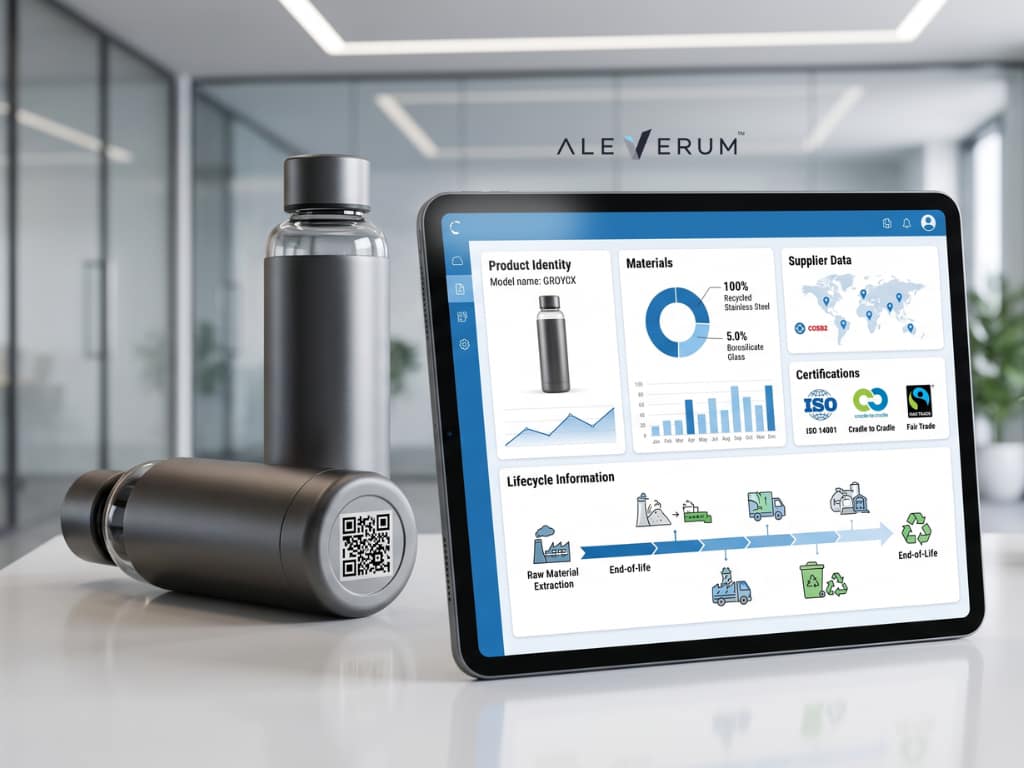
A digital product passport starts with good product data. Before choosing software or creating a QR code, businesses need to understand what information they already have, where it comes from, who is responsible for it and what evidence supports it.
This is becoming increasingly relevant for Australian manufacturers and exporters preparing for the eu digital product passport framework and supplying products into the European Union. DPP obligations are being introduced progressively across product groups, and products imported into the EU can still fall within the applicable requirements.
The practical challenge is therefore not simply publishing information. It is preparing product records that can be identified, reviewed, updated and shared reliably.
Start With the Requirements for Your Digital Product Passport
Identify the rules that apply to your product
There is no single digital product passport dataset that applies to every product.
The digital product passport regulation framework under the EU Ecodesign for Sustainable Products Regulation uses product-specific delegated acts to determine what information must be included. They can also determine the required data carrier, access rights and whether information must be managed at model, batch or individual item level.
Start by identifying the product category and the EU legislation that applies to it.
An Australian exporter should also clarify the commercial chain. Ask who manufactures the product, who imports it into Europe and which economic operator is responsible for placing it on the EU market.
This prevents teams from collecting large amounts of information without knowing whether it is actually required.
Decide which level of information you need
Product information can exist at several levels.
A model-level record might describe specifications shared by every unit of a product. A batch record may relate to one production run, while an individual-item record can contain information unique to a serialised product.
The applicable EU rules determine which level is needed for the digital product passport.
This decision affects the entire data structure.
If a product needs item-level information, for example, one general spreadsheet covering the model may not be enough. The business may need a reliable connection between the model, production batch and individual identifier.
Getting this structure right early avoids rebuilding records later.
Put Product Identifiers and Core Records in Order
Give every relevant product a reliable identity
A digital product passport needs a clear connection between the physical product and its digital information.
Under the ESPR, a DPP must connect through a data carrier to a persistent unique product identifier. The applicable product rules determine how that data carrier is presented and whether the information refers to a model, batch or item.
Before implementation, review the identifiers already used by your organisation.
Check product names, SKUs, model numbers, batch numbers, serial numbers and other identifiers used by suppliers or internal systems.
Look for duplicates and inconsistencies.
For example, if purchasing calls a product BAT-001, the warehouse calls it B001, and the product database uses another code, those records need to be reconciled before they become part of a connected DPP workflow.
Connect products with suppliers and facilities
A product record becomes much more useful when the organisations behind it are also clear.
Connect the relevant product with its manufacturer, suppliers, facilities and other responsible organisations.
For Australian exporters, this may include an Australian production facility, overseas component suppliers and the European organisation responsible for placing the finished product on the market.
The goal is not to collect every possible business detail.
It is to preserve enough context to understand where product information and supporting evidence originated.
This creates a stronger foundation for the product digital passport as information moves across companies and systems.
Connect Evidence to the Product Information It Supports

Organise certificates and supplier documents properly
A digital product passport should not become another document folder.
Certificates, declarations, test reports and technical documents are most useful when they are connected directly with the information they support.
For each important record, identify the issuer, relevant product or material, applicable facility, issue date, validity period and review status where appropriate.
Consider a supplier declaration covering one specific component.
If the document is uploaded without identifying the component, supplier or period it covers, another employee may later apply it to the wrong product.
Connecting evidence to the correct record reduces that risk.
Fix missing or outdated evidence before publishing
Product-data preparation should include an evidence review.
Check whether certificates have expired. Look for documents that refer to old product versions. Identify supplier records that conflict with information held elsewhere.
Do not automatically treat an uploaded document as approved information.
A useful workflow distinguishes between information that has been submitted, reviewed, approved, rejected or requires further investigation.
This matters because a digital record can make information easier to distribute, but it does not make the underlying claim accurate simply because it has been digitised.
Fixing these gaps before publishing is much easier than correcting unreliable information after it has entered customer-facing or regulatory workflows.
Structure Materials, Sustainability and Lifecycle Information
Connect materials and components to finished products
A digital product passport may need information about the materials or components contained within a product, depending on the applicable legislation.
Start by mapping the physical product structure.
Identify the finished product, major components, relevant materials and the suppliers or facilities associated with them.
The level of detail should follow the actual product requirements rather than an assumption that every possible material field is mandatory.
For example, a manufacturer may already have a bill of materials in an ERP or PLM system. Instead of recreating that information manually, determine whether those existing records can provide the structured source for future DPP workflows.
This also makes changes easier to manage. If a component supplier changes, the organisation can identify which products may be affected.
Prepare useful information for the circular economy
The digital product passport is also intended to support the EU’s circular economy objectives by making relevant product information more accessible across the lifecycle. The Commission describes DPPs as a way to improve transparency, traceability and opportunities connected with circular products and services.
Depending on the product rules, useful information may include recycled content, durability, repair, maintenance, recovery or end-of-life information.
A product passport circular economy approach should therefore consider what happens after the first sale.
A repairer may need different information from a consumer. A recycler may need to understand material composition. An authority may need access to information that should not be publicly available.
The goal is to maintain useful lifecycle information rather than creating a static page that becomes outdated soon after publication.
Decide Who Can Access, Change and Approve the Data

Separate public and restricted information
Not every piece of information in a digital product passport needs to be visible to everyone.
The ESPR allows product-specific rules to define which actors can access particular data. Relevant users can include customers, manufacturers, repairers, refurbishers, recyclers, market-surveillance authorities and customs authorities.
Businesses should map these audiences before publishing.
Ask which information can be public, which information should be available only to authorised partners and which information must remain restricted.
This is particularly important when supplier records contain commercially sensitive information.
Access rules should be designed around a clear business and regulatory purpose rather than simply making every available field public.
Assign responsibility for maintaining information
A digital product passport also needs ownership.
For each important data type, decide who can submit information, who reviews it, who approves it and who is responsible for updates.
Product specifications may belong to an engineering team. Supplier evidence may be reviewed by procurement or compliance. Sustainability information may have another owner.
Without defined responsibilities, outdated information can remain published because everyone assumes another department is maintaining it.
Create a simple governance process.
When information changes, the business should know what needs review, who approves the new version and whether existing published information is affected.
This is where DPP preparation becomes an operational process rather than a one-off compliance exercise.
Check Whether Your Existing Systems Are DPP Ready
Map information across the systems you already use
Preparing a digital product passport does not necessarily mean replacing your existing business systems.
Product information may already exist in ERP, PIM, PLM, asset-management, supplier or document-management systems.
Start by identifying the source of each important record.
For example, product specifications may come from a PIM, supplier details from an ERP and certificates from a document-management system.
Then determine whether the information can be connected reliably.
A digital product passport platform can become part of this information flow, but it should not automatically duplicate every source system.
The better question is: which system is authoritative for each type of information, and how should approved data move between systems?
Fix data quality before automating integrations
Connecting systems does not automatically improve the information inside them.
An API can transfer incorrect data just as efficiently as correct data.
Before investing heavily in integrations, check for duplicate product identifiers, missing suppliers, inconsistent units, expired evidence and conflicting descriptions.
Test the process using one real product.
Follow its information from the original source through review and into the proposed passport output.
The ESPR requires DPP information to use open standards and interoperable formats and, where appropriate, be machine-readable, structured, searchable and transferable without vendor lock-in.
That makes clean, structured source data particularly important.
Choose the Right Digital Product Passport Platform

Compare platforms using a real product workflow
Once the product data is understood, businesses can compare digital product passport platform options more effectively.
Do not choose passport software solutions only because they can generate an attractive QR-code page.
Ask how the platform manages the information behind that page.
A useful evaluation should consider product, batch and item records; suppliers and facilities; evidence relationships; review workflows; permissions; version history; structured outputs; integrations; data portability and DPP Registry workflows.
The EU DPP Registry is now operational. It stores unique identifiers and associated metadata, while the underlying product information remains decentralised.
Ask shortlisted providers to demonstrate a real change scenario.
Upload a product record and supporting evidence. Approve it for publication. Then replace a supplier certificate or change a relevant product value.
Check whether the previous version remains traceable and whether the updated information follows the correct review process.
That tells you far more than a static demonstration.
Know what the platform does and what remains your responsibility
A digital product passport platform should make responsibilities clearer, not hide them.
Aleverum is one option for organisations that need to structure product, supplier, material and lifecycle records, connect supporting evidence, manage review and approval workflows, control permissions and prepare approved DPP outputs.
Importantly, the platform distinguishes product-data governance from certification and regulatory approval. Customers remain responsible for the accuracy, completeness and evidentiary basis of information they approve or publish.
That distinction is useful when comparing any provider.
Ask what the platform manages, what remains with your internal team and when an external verifier, auditor or specialist is required.
For Australian businesses, a sensible first step is a small readiness exercise rather than a large implementation.
Choose one representative product. Map its identifiers, suppliers, materials, evidence, lifecycle information and existing systems. Then identify what is complete, what needs review and what is missing.
Only after that should you decide how much technology is required.
A reliable digital product passport begins with information that can be identified, supported, reviewed and maintained. Choosing the software becomes much easier once those foundations are clear.
